

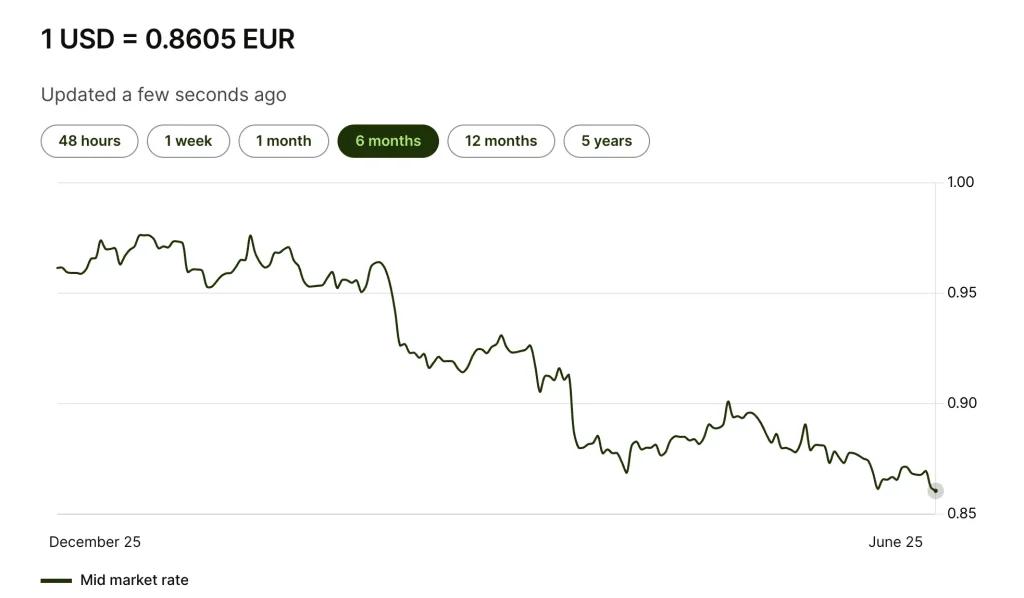
We arrived in France in January 2025. That month, the USD:EUR exchange rate had climbed to 0.97:1 and was on track to reach parity at 1:1. Because we’ve worked and invested in the US for our entire careers, all of our retirement planning was done in Dollars. Apartment searching, grocery shopping, vacation planning; we imagined all of our costs as if they were in Dollars, not Euros. We felt great about the cost of living and our budget.
Then the tariffs started.
Within three months we’d lost 10% of our purchasing power as the rate dipped below 0.87:1, with no indication that it would stop falling. To make things worse, US stocks were entering into bear market territory with a loss of 20% from all-time highs in January and February. It looked as if Sequence of Return Risk was about to sink our retirement before it was anything more than a long and expensive vacation.
What we learned the hard way about the hidden risks of spending in a foreign currency
Everything in the Financial Independence space is built upon the 4% rule. But the original Trinity Study is based on the S&P 500 index, made up of American companies. The inflation data used is all based on US inflation. And of course, there is no currency exchange, everything is in US Dollars.
But what about the expat retiree? Does America’s inflation rate even matter, if you don’t live there?
The easy answer is that exchange rates don’t matter, you simply withdraw 4% from your portfolio, convert it to your local currency, and get what you get. If the rate is up, that’s more money for you to spend. If it’s down, you’ve got less. And if the local economy experiences elevated inflation that isn’t balanced out with a weakening currency, you simply continue to lose purchasing power each year.
But what if spending less in the down times isn’t appealing? The beauty of the 4% rule, after all, is the predictable amount of withdrawals, good times or bad.
Unfortunately, there’s no such thing as a free lunch. Spending in a different currency adds additional volatility, not to mention fees, that simply isn’t rewarded by the market. Hedging against currency risk increases cost, requires a portfolio rebalance, and has major tax implications too. So what can you do?
3 ways to protect yourself from currency risk
1 – Diversify into more international funds
The US stock market makes up just over 60% of the global market cap. Overweighting US stocks can leave you vulnerable to a weakening US Dollar. Home country bias is something we’re guilty of, having 80% US stock and only 20% international.
Keep in mind that rebalancing to a heavier international portfolio now can be a form of market timing and performance chasing. Consider slowly adding in more international every year while rebalancing rather than all at once.
2 – Invest in local real estate
Buying a home can be a great way to increase exposure to your new home country’s economy. Borrowing money for a mortgage is a great hedge against inflation, but still carries long term currency risk. Buying in cash can eliminate the long term currency risk, but is still exposed to phantom capital gains tax.
While we’re currently renting, we do plan to buy a home in the near future, hopefully with a mortgage at a much lower rate than what’s available in the US.
3 – Start a local business
While not in line with the idea of retirement, earning money in the local currency is a great way to eliminate currency risk. This doesn’t have to be a full time, in-person type of business either. We know plenty of expats who own and manage a few local AirBnBs and only need to put in a few hours per week.
The VLS-TS visitor visa doesn’t allow work in France, but rental income is categorized separately, as long as it stays below a certain limit.
Conclusion
As of late June, 2025 the US stock market has recovered most of its lost value, but the Dollar is still well below where it was earlier this year. Our budget is based on USD, so our lifestyle and disposable income have been trimmed down quite a bit. We’re less concerned with Sequence of Return Risk hitting hard, but looking to hedge against further weakening of the Dollar.
Looking ahead, I’d like to research whether a safe withdrawal rate exists for a fixed Euro budget coming out of a USD portfolio. I’ll create a Part 2 post with the findings.
Questions? Comments? We’d love to hear from you in the comment section or feel free to write us directly.
🥖 🧀 🍷



Leave a Reply