
Understanding French Healthcare (Part 2): How Mutuelle Insurance Works
One of our biggest drivers for leaving the US and immigrating to France was access to affordable, high-quality healthcare. We wanted to live somewhere where the quality of care was equal to or greater than what we had access to in America, but at a price point we could actually afford.
Healthcare in France is certainly more affordable than the US, and France is ranked much higher than the US (#20 vs #69) for Best Healthcare in the World. But how does this actually translate into real-world experiences?
Earlier this year, we successfully applied for and received our Cartes Vitales. Since then, we’ve had multiple doctor appointments, specialist visits, and physical therapy sessions. We’ve been quite busy catching up on two years’ worth of delayed care. Here’s how our experience in France compares to what we’ve experienced in the US.
Disclosure: Some links in this article may be affiliate links. If you choose to use them, we may earn a commission at no additional cost to you. We only recommend services we believe are genuinely useful.
How the Carte Vitale works
France has a universal health care system, meaning all residents are assured access to medical care. The government sets expected fees for visits and services, but individual doctors or hospitals can exceed these fees and charge more.
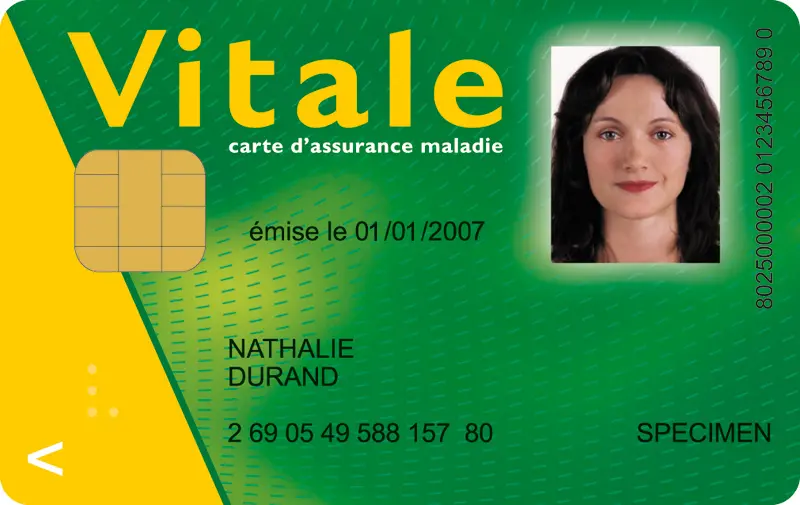
Anyone legally residing in France for more than three months (just beyond the tourist stay limit) can join the social security system, receiving a physical Carte Vitale as an ID. This card is then used to receive reimbursements on health care fees. The reimbursements vary, but are generally around 70% of the expected fee set by the government, even if the actual fee is higher.
Anyone, tourist or resident, can go to a doctor or hospital in France for medical care, and will be charged the same. But only residents with a Carte Vitale will be reimbursed for some of those costs through the social security system.
New residents on a VLS-TS visa are expected to have private health insurance, and would instead be reimbursed by their insurance company.
Supplemental Insurance
Almost every resident in France carries supplemental insurance, referred to as a Mutuelle. These reimburse varying amounts, but will usually cover at least the other 30% of the expected fees not covered by the government’s 70%, marketed as 100% coverage.
Because many health care providers charge above the set fees, more expensive mutuelles will offer 125% to over 400% coverage.
As a quick, oversimplified example, the base rate for a general practitioner visit is €30. The government will reimburse 70%, €21. A 150% mutuelle would additionally reimburse up to 80% (150%-70%), €24. Total reimbursements would be up to €45 (€21+€24), and any cost above that would be paid out of pocket.
How the costs compare
Growing up in the American healthcare system, the costs in France are almost unfathomable. €30 to visit the doctor, €60 to see a specialist, €20 for a PT session. Being uninsured in France is drastically cheaper (and easier) than being insured in the US.
Add in the Carte Vitale, which reimburses 2/3rds of the costs, and it gets even better. It’s entirely feasible for retirees with a nice cash cushion to simply self-insure and skip the mutuelle altogether. Without an employer paying a portion of the premiums, you’re more likely to save money over time with this approach.
Mathematical advantages aside, we did decide to purchase a mutuelle. We felt that separating the financials from the decision to go to the doctor would make us more likely to go for care when we needed it, rather than put it off like we did when we had HSAs. It costs us about €1000/year for the two of us, and should cover just about all of our healthcare expenses.
- Feather offers a great mutuelle plan, with competitive pricing and English support. Get €15 off per policy with code FRANCEFI.
Now when we go to an appointment, we either pay nothing and the cost is billed directly to the mutuelle, or we pay the ~1/3rd not covered by the Carte Vitale and send the bill to the mutuelle, which then gets reimbursed to us and deposited into our French bank account.

How the experience compares
Our experience so far of the medical system in France has been quite different than the US. While we (luckily) haven’t been in any French hospitals, we have had quite a few appointments with different doctors and specialists.
Gone are the strip mall practices with sparkling white interiors and friendly receptionists. Most of the specialists we’ve seen have had offices inside regular apartment buildings in the city center. With no receptionist, you simply enter (make sure to say Bonjour) and sit in the living room, converted into a waiting room. The apartment may be shared with several doctors, and only sometimes do they have a shared receptionist, who is rarely friendly and often makes mistakes on your forms.
Once in your doctor’s office, things feel fairly similar. There’s no nurse to do the dirty work, but the doctors are all professional and courteous. The visits are often timely and brief, getting straight to the point quickly. It’s not uncommon to pay the doctor directly at the end of the appointment, either with credit card or simply cash.
The General Practitioner
The General Practitioner (médecin traitant) in France acts almost like a bureaucrat in a white coat. Beyond just getting prescribed medicine, a prescription (ordonnance) is used for seeing all types of specialists in France. Each person is expected to choose a GP, and they should be consulted before going to a specialist.
In reality, the GP acts as a gatekeeper for more specialized care. In our experience, they’re very quick to write any and all prescriptions/referrals desired, but they do slow things down significantly. Need an X-ray, an MRI, and then to see a specialist after? That’s three trips to the GP in between each step. If they’re booked out for a week or more, things really get dragged out.
There’s a shortage of doctors in many parts of France, and we suspect that the GPs are tasked with throttling the rate of healthcare available to patients.
Capitalism vs Socialism
One marked difference between the US and French medical experience is their approaches towards ongoing care and scope. The Capitalist American approach is to push more expensive treatments and medications, boosting profits. The Socialist French approach is to limit unnecessary medical expenses and testing, preserving the system for others.
In the US, it feels like an upsell. There are constantly ads on TV for new drugs. The doctors want more tests and prescriptions. The dentists all think you need Invisalign. They’re not shy about leaving no stone unturned, at great cost to you and your insurance. But if you’re willing to pay for a specific treatment or want another test, it’s never a struggle to get it.
In France, the approach is much more conservative. The doctors want to try one thing at a time and are willing to just wait and see, especially before prescribing antibiotics. If there’s a specific test or treatment you feel would be beneficial but your doctor doesn’t, it can be an uphill battle to get it. But the treatment you do get prescribed is much more likely to be necessary and isn’t paying your doctor a kickback.
Ultimately, both systems have their pros and cons. If you can afford it, the US grants access to all the treatment you might need, and maybe some extras pushed on you that you don’t really need. It’s the aggressive, shoot-from-the-hip approach.
France has a much more conservative, reserved approach to healthcare. It may require some coaxing to get an out-of-the-box treatment, but it won’t ever bankrupt you in the process.
Conclusion
France and America have two different approaches to healthcare. Neither is necessarily better than the other, and most people are born into one or the other and never get an opportunity to choose. But as expats, we’re in the privileged position to experience both systems and choose which we prefer.
As you may have guessed from the website theme, we’ve chosen France, and a large motivation was healthcare. Having access to affordable healthcare is a key piece to our overall quality of life, one that didn’t exist in the US.
We feel the system here in France will lead to better health outcomes overall. Do you agree or disagree? Let us know in the comments below.
🥖🧀🍷



Leave a Reply