
Understanding French Healthcare (Part 1): Using our new Carte Vitale
The public healthcare in France isn’t free. After living in France for three months, residents qualify to join the healthcare system (Sécurité Sociale) and receive a Carte Vitale. But the Carte Vitale only covers up to 70% of healthcare costs. The rest is either paid out-of-pocket or covered by supplemental insurance, aka mutuelle insurance.
But with at least 350 different insurance companies in France offering mutuelles, and each company offering several plans, the choices can be dizzying. What does it mean to cover 150% of a doctor’s visit? Are dental and vision separate? What about pre-existing conditions?
In this article, we’ll break down the different features of a mutuelle, how they work, and if they’re worth buying.
However, the greatest resource available to you is the insurance agents themselves. Towns are peppered with their agencies as the French prefer to deal in person rather than online. Find an agent who speaks English if your French isn’t great and ask them all the questions you have. Our experience has been overwhelmingly positive. They’re often friendly and rarely pushy, recommending what they think you’ll need, not upselling a more expensive plan.
Disclosure: Some links in this article may be affiliate links. If you choose to use them, we may earn a commission at no additional cost to you. We only recommend services we believe are genuinely useful.
What is a mutuelle?
Applying for a VLS-TS Visitor visa requires having health insurance coverage for the first year. Three months in, you can apply to join France’s healthcare system. After being approved and receiving your Carte Vitale, a process that can sometimes take months, you can convert that insurance into a mutuelle.
Mutuelles act as “top-up” insurance. They cover fees that aren’t reimbursed by the government through the Carte Vitale. Because of this, they should be significantly cheaper than the standalone insurance needed for the VLS-TS application. France’s healthcare system reimburses first, then the mutuelle picks up the slack.
Unlike traditional for-profit health insurance companies, mutuelles de santé are non-profit businesses managed by democratically elected members. They’re regulated through a legal code that, among other fascinating things, prevents them from offering premiums based on individual risk. That means there are no pre-existing conditions clauses like in the US. Have diabetes, heart disease, and cancer? You can still be covered for the same cost as if you were healthy.
How do mutuelles work?
When you choose a mutuelle, it gets linked directly to your Carte Vitale and will show up on your Ameli account. Unlike in the US, where the doctor bills your insurance and your share is billed later, in France, you usually pay up front and get reimbursed later. Some providers will only bill for what the Carte Vitale won’t cover, but many bill for the full amount. Luckily the reimbursements happen automatically, for both the Carte Vitale and your mutuelle. Within a week or two, you’ll have the reimbursement deposited directly into your French bank account, without needing to fill out a form or make a phone call.
Reimbursement percents

The key piece about mutuelles is understanding the reimbursement percentages. The most basic plans cover charges up to 100%, but the highest can cover over 200%. These percentages are all based on the fees fixed by the French Health Insurance scheme.
For example, the cost of seeing a GP is set by the government to €30. However, only doctors within Secteur 1 will actually charge only €30. Many healthcare providers fall into Secteur 2 or 3, where they can charge above this rate. The reimbursed amount is still based on the set fee, though, not the actual amount charged.
For the €30 GP visit, the Carte Vitale will reimburse 70% of that, minus €2 as a flat fee (like a copay in the US): €19. Regardless of whether the doctor charges €30 or €50, CPAM will reimburse you €19. Without a mutuelle, you’d pay for the rest: €11 for a €30 charge or €31 for a €50 charge. With a mutuelle that covers 100%, they reimburse up to 100% of the set cost, €30. So the €30 visit would be fully covered, but the €50 visit would still leave you owing €20. If you instead had a plan that covered 150%, you’d be covered up to €45 (150% of €30), and the €50 visit would only cost €5 out-of-pocket. The percentages of coverage are all based on the government’s set fees.
Reimbursement categories
Most mutuelles cover different types of healthcare at different reimbursement rates. There are usually four different categories: routine care, hospitalization, dental, and vision. The most basic plan may only cover hospitalization, but most cover all four areas. Things get complicated here very quickly, with some coverage in total Euros, some limits being per eye or ear, and certain categories listed as Frais réels, or actual cost.
This is where you can customize your coverage to fit your needs. Have great eyes and teeth? You could save by only carrying coverage for hospitalizations and routine care.
Deductibles, out-of-pocket maximums, etc.
While the different categories and types of reimbursements can be confusing, everything else is quite straightforward. There’s no such thing as a deductible or out-of-pocket maximum; the reimbursed amount is always the same, from day one.
Similarly, there are no networks to be in or outside of. As long as you have a prescription from your GP, it’s covered. Want to shock and horrify at a French dinner party? Try to explain what Prior Authorization is.
Is mutuelle coverage worth it?
With how affordable healthcare in France is compared to the US, even without any insurance coverage at all, self-insuring can be an attractive option. No one in France has ever gone bankrupt from medical debt, so is insurance really necessary? Mathematically speaking, self-insuring is expected to be a better deal than buying insurance.
This is the line of thinking we had for our first six months in France. We looked at the calculators over and over and couldn’t justify the monthly cost of insurance compared to our expected out-of-pocket costs. But knowing that almost every single French person has a mutuelle and that every doctor strongly recommended having one got us to sign up eventually.

Has our mutuelle paid off?
For us… no. Luckily, we’ve had no major health issues in the few months we’ve had the policy, so we’ve paid in quite a bit more than we’ve received. For routine doctor visits, the cost after the Carte Vitale reimburses us has been much lower than our monthly insurance payment. We also haven’t struggled to find Secteur 1 doctors, so our costs have been in line with the set fees.
But we’re not insuring against the cost of routine doctor visits. We’re insuring against a major hospitalisation or complicated surgery. Hopefully we never make full use of our policy, but paying €500 each per year to be fully covered seems well worth it. Plus, it makes budgeting for healthcare extremely simple: €1000 for both of us. (Or so we hope…)
There’s also a psychological factor to having all our medical visits already paid for. We’re much less likely to put something off or wonder if it’s worth the cost. After years of carrying only catastrophic coverage while traveling and a lifetime of high-deductible plans in the US, it’s a huge relief to seek care when needed, without worrying about cost.
Tips for choosing a mutuelle
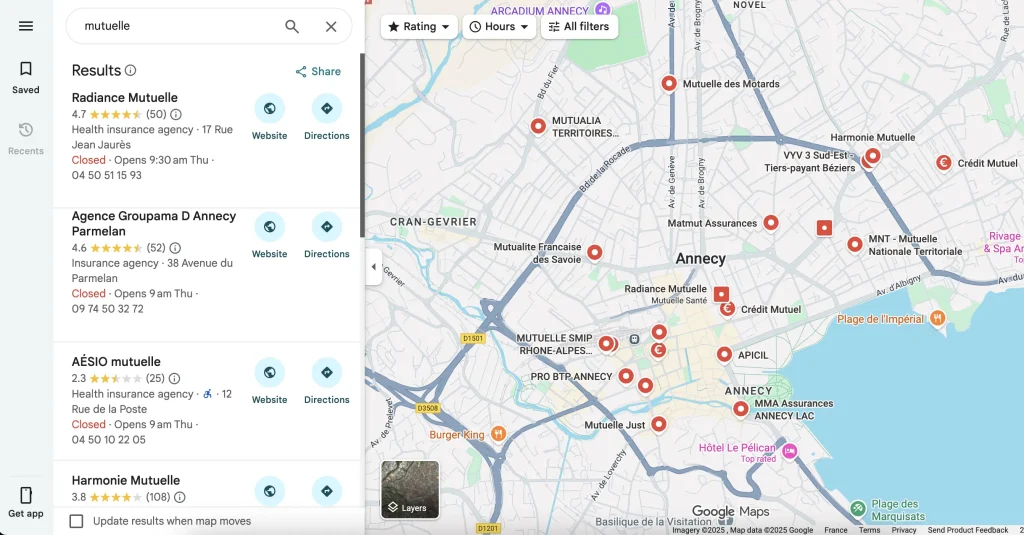
We believe your best bet for finding a mutuelle is to ask for quotes in several local offices. The agents will be able to answer any questions and recommend a level of coverage based on the healthcare landscape of your town. Take the quotes home and compare them, then pick your favorite.
If you’d like to shop around online first, Les Furets is a great online tool for comparing different insurance policies in France. It’ll give you a good idea of how much plans will cost and what will be covered.
Feather now offers a great mutuelle plan as well, with competitive pricing and English support. Get €15 off per policy with code FRANCEFI.
Conclusion
Choosing a mutuelle is a very personal decision, and we can’t really recommend any one over the others. We’re glad to pay for full coverage (150% in Annecy, according to our agent) and not need to consider cost when seeking care. But the amount of coverage really depends on personal needs.
Questions? Comments? We’d love to hear from you in the comment section or feel free to write us directly.
🥖 🧀 🍷




Leave a Reply