Two years ago, sitting on a beach in the South of France, we decided to take the leap and move here.
Two years ago, I decided to start learning French, starting from absolutely zero.
I started where most language learners probably do: on Duolingo. And I stubbornly stuck with it every single day, for two whole years.
So after two years of daily learning, have I managed to actually learn any real French?
Disclosure: Some links in this article may be affiliate links. If you choose to use them, we may earn a commission at no additional cost to you. We only recommend services we believe are genuinely useful.
What is Duolingo?
For those who don’t know, Duolingo is a very popular website and smartphone application for learning languages.
Duolingo uses “gamification” to encourage everyday learning, trying to use the same psychology that makes video games and casinos addictive to get people to stick with the long, slow grind of language learning.
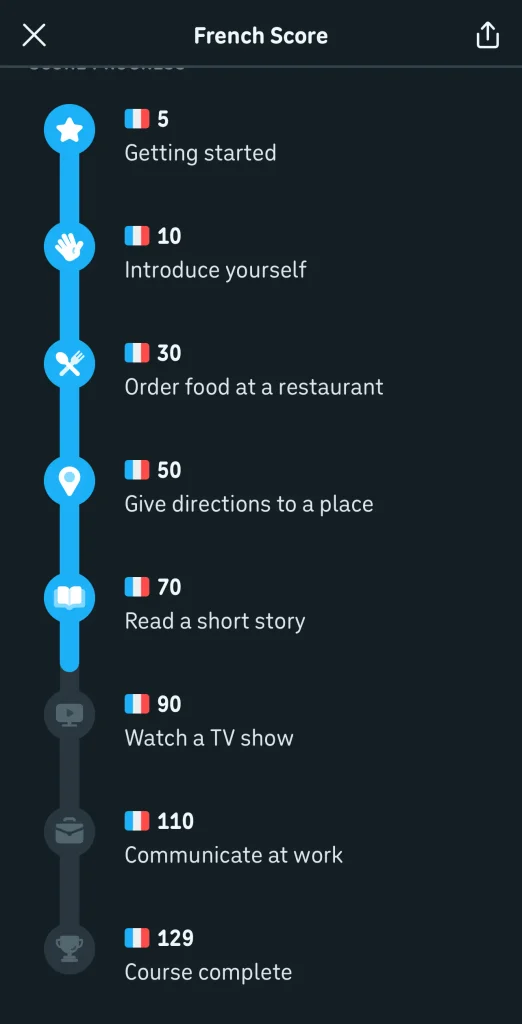
There’s a combination of speaking, reading, listening, and writing exercises with a slow progression from zero to “Communicate at Work” and course completion.
Instead of teaching grammar rules and verb tenses, the lessons are all based on simple repetition and pattern matching.
Duolingo competes with other daily learning platforms such as Babbel, but is by far the most popular option.
Duolingo’s pricing
One of the main reasons for Duolingo’s popularity is its pricing. It’s free to use but includes advertisements, with a paid “Premium” option to skip the ads and keep learning for longer.
As of fall 2026, Duolingo costs $13/month or $84/year in the US and €11.50/month or €100/year in France for the entry-level premium subscription.
My French level after two years
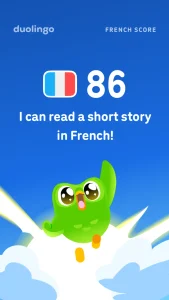
After two years of using Duolingo as my main French teacher, according to the app, I can “Read a Short Story” but I’m not quite to “Watch a TV Show” level yet. Before they removed references to the DELF language levels, this was roughly B1.
I find these descriptions fairly accurate. My reading comprehension is probably my strongest skill in French, but I’m still using subtitles and 0.8x speed to understand French videos on Youtube.
I’m able to understand a lot of formal spoken French, whether at the doctor’s office or watching the news. But when it’s the informal French of daily life, I really struggle.
I’ve primarily stuck with 15-20 minutes per day, although occasionally it’s only 30 seconds and sometimes as much as 30 minutes.
At this pace, it took me about four months to finish the A1 lessons (0-29), eight months for the A2 lessons (30-59), and it’ll likely take about 16 months for the B1 lessons (60-99).
Each DELF level has required twice as much time as the previous. Finishing all the courses and reaching B2 level, enough for French citizenship, will take me about 5 years total at this pace.
What Duolingo does well
Duolingo is fantastic for building vocabulary and getting daily practice. Words and sentence complexity are slowly built over time, and then repeatedly practiced until they stick.
Because I’m learning French for daily life and not for school, the focus on repetition instead of formal grammar lessons works really well for me. I’m not particularly interested in the names of all the verb tenses, just when to use them while speaking.
The gamification aspect of the app also keeps me extra motivated to learn. There are rewards for doing a lesson every single day, and it’s worked to keep me coming back daily for two years straight.
Where Duolingo falls short
Duolingo’s biggest weakness is a lack of feedback on pronunciation. While there’s a very rough system for using the microphone to speak, the app never lets you know if you’re actually pronouncing things correctly. This can lead to lots of incorrect repetition, which can be hard to correct later on.
Duolingo also doesn’t explain why. While the repetition format may work well for children learning a language, it can be frustrating as an adult who doesn’t understand why things are the way they are.
Finally, it can be frustrating to have no control over which words and phrases get repeated as practice and which don’t. I find the app constantly having me repeat words that are identical or very similar in English, while I forget more difficult words and phrases that I actually need practice on. For example, I’ve had to repeat normalement (normally), effectivement (effectively), and généralement (generally) every day for over a month, but really only needed one day to learn them.
What I add to get the most out of Duolingo
On its own, Duolingo is not enough to properly learn a language. But I find it works incredibly well as one tool within an array of many methods of learning.
One of the most essential complements to Duolingo is a way to work on pronunciation. The best way is to struggle through speaking French with someone fluent. I’m lucky enough that my wife can correct my pronunciation, but I’ve also used online and in-person language exchanges and videos dedicated to proper pronunciation.
Duolingo also doesn’t highlight everyday spoken French well. For that, I watch a lot of Youtube videos. Because I still struggle with oral comprehension, I enable subtitles in French and slow down the video until I can understand it, usually around 0.8x speed.
Finally, I added a French class on Udemy to learn more of the formal rules of grammar and conjugation. It really helps to fill in the gaps left by Duolingo’s repetition-only approach.
Is Duolingo Premium worth it?
Because of the huge amount of time that watching the advertisements can take, multiplied across every day for several years, I find the Premium subscription to be well worth it.
I also have the additional motivation to keep using the app because I’ve already paid for the whole year, and I don’t want to waste the subscription.
My two-year review of Duolingo
After two years of using Duolingo every single day to learn French from A0 to B1, my experience with Duolingo has been overwhelmingly positive.
I feel the app is a great fit for my learning style and routine. However, it’s definitely not for everyone, and I feel it’s essential to pair it with other tools for learning a language.
As a stand-alone application
⭐️⭐️☆☆☆ – 2/5
Used as the only approach to learning a language, Duolingo falls far short and leaves way too many gaps. It doesn’t matter how large your vocab is if you can’t pronounce any of the words.
If someone is hoping to only use one application to learn a language, it shouldn’t be Duolingo. I’d likely steer them towards 1-on-1 coaching instead.
As the vocab and repetition tool among others
⭐️⭐️⭐️⭐️☆ – 4/5
When used in combination with other tools, Duolingo can be fantastic for building up vocabulary and having daily exposure to level-appropriate language content.
While it does have some weak points and frustrating features, overall it’s a great tool that has helped me immensely.
Want to share your experience with Duolingo or another platform? We’d love to hear from you in the comment section, or feel free to write us directly.
🥖 🧀 🍷




Leave a Reply