

It’s a relaxing Sunday evening in late July. Most businesses in France are closing for summer holidays. Everyone is excited for their vacations.
An email from Les Impôts pops up just before logging off for the night. Surely this is confirmation that the tax treaty worked and there’s nothing owed, right?
Wrong. It’s a surprise tax bill for €6000, and they’ll be helping themselves with an automatic bank withdrawal. Rude.
Panic sets in as we realize our tax treaty dreams are sinking. It must really have been too good to be true after all.
Could this be the end of France-FI?
Our Big Tax Surprise
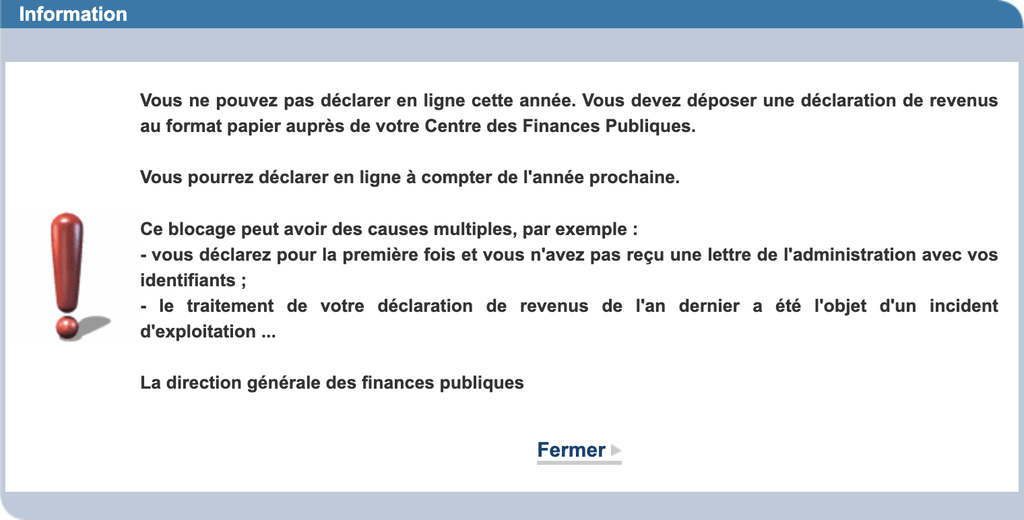
As we log in, things go from bad to worse. Because we had (been forced to) submit a paper filing, our digital return has been “corrected” by someone at the tax office.
None of our capital income is in box 8TK any longer (now in 8PL), meaning we owe tax to France on it, offset only by taxes paid to the US. As we’re firmly in the 0% US capital gains bracket, this means bearing the full weight of France’s 30% tax.
And yet, strangely, there’s a credit for foreign taxes paid in box 8VL of Form 2042-C. Except we never filled out box 8VL. We never paid taxes to a foreign state (the US), nor did we declare that we did. And yet, generously, we were credited with it.
Upon deciphering our new tax return, only our retirement income stayed in Box 8TK. Our capital income was moved to Box 8PL, and an imaginary foreign tax credit appeared in Box 8VL.
Digesting The New Return
A wave of relief sets in. What’s more likely, the US-France Tax Treaty is wrong, or there’s a grave error in their software and the French tax office is digitizing Americans’ tax returns incorrectly?
After living in France for a few years, we’ve seen first-hand how poorly their digital systems are built and how frequently there are errors.
Without a doubt, this is their error. But now we still have to prove it.
France-FI vs Les Impôts
Round 1 – The tax office
We book the first available appointment with our local tax office. While waiting, we re-read the treaty and gathered evidence, ready to fight these heinous charges. We pulled from as many official sources as we could find (there aren’t very many), realizing that “someone on Facebook said so” wasn’t going to cut it.
On the day of our RDV, we made the trek out to the offices and queued up behind other happy souls, excited to be doing taxes at 8:30am.
We met with our tax bureaucrat, ready to come out swinging. The first thing she said to us? She was going to call us but forgot; no need to have an in-person appointment for this. She read our message and will “take a look” at our return and cancel any withdrawals from our bank account in the meantime.
A bit anticlimactic but we take the win.
Round 2 – More paperwork
A few days later, we receive a message on the online portal. An apology? No. An admission of a mistake? No of course not. It’s a simple request for more documents, proof that this was indeed American income and that we are a part of the American social security system.
First we try to push back, saying all of our income was in the accounts we declared on Form 3916-BIS and they could verify it all there. After all, isn’t that the point of declaring every single account?
The tax office isn’t having it. We end up simply uploading our 2025 US tax return as “proof” of American income and the first page of our Social Security statement from ssa.gov.
Round 3 – The grand finale
In the end, we received a heartfelt apology for the horrible mistake and a lengthy explanation for how their system error caused such chaos. They promised to go over all other digitized paper filings to ensure no one else receives a surprise tax bill, and assured us they’d strive to do better next year.
Haha just kidding.
After a few weeks of waiting, we received a cryptic message that the account withdrawal was canceled and we now owed €0.
No admission of guilt, no indication of a system error. We didn’t even receive an updated tax filing with our numbers in the correct boxes. C’est la vie.
Our Tax Resources
For anyone else finding themselves in a similar situation, here are some of the resources we prepared to counter France’s claim to both income tax and social charges on our American income:
- Income Tax
- The 2047-NOT notice for Form 2047 specifically mentions Article 24 1-b-i of the tax treaty, where US citizens residing in France receive a credit equal to French taxes owed, not a credit for foreign taxes paid, for both dividends and interest.
- Article 24 1-b-ii of the tax treaty specifies that capital gains from investments generating dividends or interest covered by 24-1-b-i receive a credit equal to French taxes owed.
- Social Charges
- Social charges are considered income tax within the scope of the US-France Tax Treaty.
- Foreign-source income that qualifies—under an international tax treaty—for a tax credit equal to the French tax corresponding to that income is not subject to the withholding of social security contributions and levies.
Questions? Comments? We’d love to hear from you in the comment section, or feel free to write us directly.
🥖 🧀 🍷





Leave a Reply