Moving abroad adds a whole new level of complexity to personal finance that you may be unfamiliar with: currency conversion. Every purchase now has an extra step of mental math as you calculate the cost in your own currency, using a rate that’s constantly changing.
While travelers and tourists can usually get away with letting their credit cards handle all of the conversions, living in another country separate from your financial center requires more care to avoid exorbitant fees.
This guide serves as a baseline for anyone earning in one currency and spending in another. For us, our US savings and investments yield dollars, but all of our expenses in France are in euros. This is how we handle the difference.
Disclosure: Some links in this article may be affiliate links. If you choose to use them, we may earn a commission at no additional cost to you. We only recommend services we believe are genuinely useful.
Investing in Dollars vs Euros
We plan to stay in France long-term, so why not just move all of our investments here and convert everything to euros?
That would eliminate the problem of currency conversion and simplify managing money in France considerably. We wouldn’t need to follow politics so closely and worry about what Trump might do next to further weaken the dollar. It may even strengthen our eventual citizenship application.
Unfortunately, that would create more problems than it solves, especially for US citizens like us.
Taxes and PFICs
First and foremost, the taxes. From both countries simultaneously, they’d be brutal.
First, you’d owe tax on any realized gains from selling or converting shares. The US-France tax treaty should protect you from French taxes on those gains, but you’ll still owe US capital gains tax and potentially French social charges.
To reinvest into a euro-based fund is where things get awful for Americans. Any fund domiciled outside of the US, which any euro-based fund likely will be, opens you up to potential PFIC requirements. Whatever minor currency savings are to be had would be bulldozed by increased taxes and administrative costs.
Essentially, Americans are strongly discouraged from investing outside of the US market. But that’s ultimately not such a bad thing.

Non-American Investment Options
While it may be a bummer to not be able to buy non-American investments, the reality is that America already has all the best investment options.
Capitalism and a strong bias towards rich corporations mean that the US has all the best investment opportunities at the most competitive prices. And being an American, you have easy access to all of them, without jumping through hoops that most foreign investors must.
So ultimately, leaving our investments in US funds and having a monthly/quarterly currency conversion is what works best for us, and likely for most US expats.
USD:Eur Rates
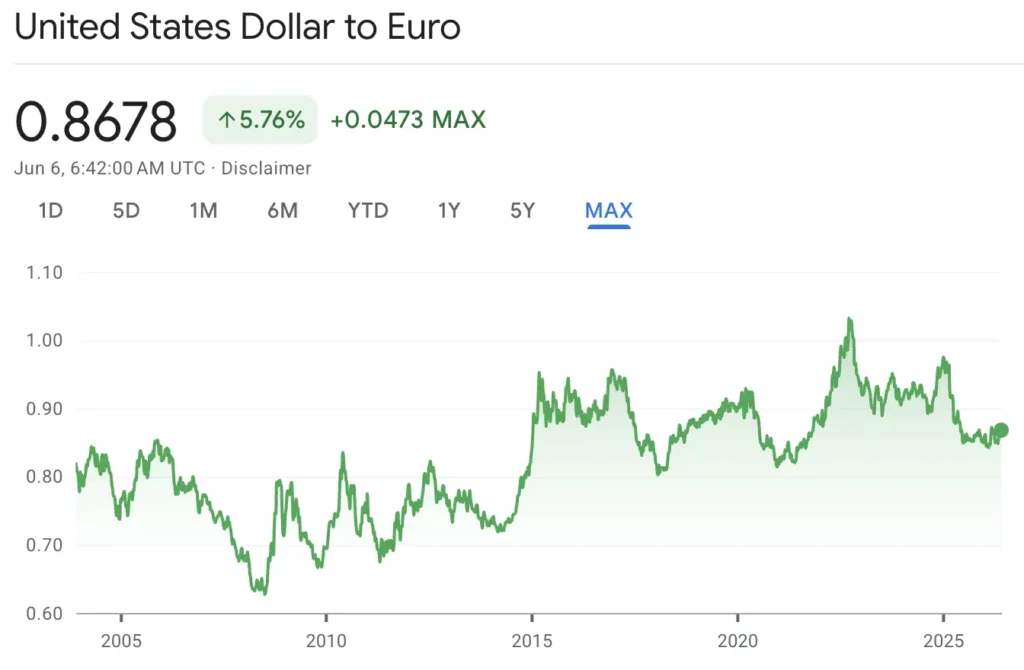
While the dollar has recently lost significant value against the euro and may continue to do so while Trump is in office, it’s still above the historic average for the currency pair. Additionally, the interest rate for dollars is significantly higher than for euros.
Keep all these factors in mind when deciding how much cash to hold in euros vs dollars.
Daily Expenses
While there are still a few holdouts at the marché, France has become a cashless society with most people opting for contactless payment. That leaves two options for daily spending.
Debit Card – The Local Option
Carte Bancaire in French usually refers to paying by debit card, although any Visa/Mastercard will work. When most French are using contactless payment, they’re simply paying with their debit card. With a lack of credit scores and an aversion to debt (and consumerism), credit cards aren’t really a thing here.
The simplest option for daily spending is to do as the French do and hold euros in a local bank account, paying with your debit card. You’ll forgo earning points, having extra consumer protections, and likely pay a monthly fee to your local bank for the privilege, but that’s how most locals do it.
Credit Card – The Foreign Benefit
Access to American credit can be a double-edged sword. But if you’re a responsible spender who pays off your cards every month, that sword can be wielded extremely effectively.
A solid card with no foreign transaction fees provides convenience, credit card points, and consumer protections. There’s usually some loss on the currency exchange spread, but it’s less than 1% and should be completely offset by the points earned.
We’d recommend having at least two cards loaded onto your phone’s wallet before arriving in France. We’re particularly fond of the Capital One Savor card for the 3% cash back at grocery stores and no annual fee. But any card without foreign transaction fees will do. Check out our Resources page for more recommended products.
Cash Spending
While cash has become rare in France, we do still need it occasionally. To access ATMs, we maintain two checking accounts: a local bank and an international bank.
The local bank
Having a local bank with a French IBAN is essential for life in France. Withdrawing through their ATM network is the simplest method to get cash when needed.
The international bank
We’ve kept our Schwab Checking account open, mainly for the ATM fee reimbursement benefit. It’s served us extremely well. Not just in France, but in any country we’ve visited. Whenever we need cash, we just withdraw from a local ATM. Schwab reimburses all of the ATM fees, making it the absolute cheapest way to get cash anywhere in the world.
Monthly Expenses
There are quite a few monthly recurring expenses that require a bank transfer to pay. Rent, utilities, cell phone plans, and gym memberships are all payable only through a bank transfer.
A local bank works for these charges once established in France, but it’s a great idea to have an account already open before arriving. We’ve been very happy with Wise and still use it for paying most of our bills, despite now having a local account.
For us, Wise is the simplest and easiest way to convert dollars into euros. The rates are competitive, balances earn interest, and the fees are about 0.3%, meaning we pay $3 in fees for every $1000 converted.
Wise’s euro account is considered a foreign account, so be sure to file an FBAR if you hold more than $10k (equivalent in euros) at any point in the year. We made our car purchase through Wise, so we’ll have to do that as well.
Read our full Wise review here.
Large Purchases
For really big foreign exchange transactions, sometimes we ditch the convenience of Wise for an even better conversion rate. With Interactive Brokers (IBKR), we’re able to get a 0.2% conversion rate fee on our FX transactions.
While the fees are the best around, IBKR lacks the convenience of Wise for paying bills and transferring money. We usually move our converted euros into Wise for spending, which is what we did for buying our car.
We do hold our investments at IBKR, and they’re one of the few brokerages that outright support American clients living in France. As a bonus, we’re also able to save on translation costs for our Proof of Financial Means when renewing our Carte de Séjour by generating our statements in French and using euros as our default currency.
Questions? Comments? We’d love to hear from you in the comment section, or feel free to write us directly.
🥖 🧀 🍷




Leave a Reply